
The dashboard says “green.” The annual assessment is done, the latest framework update is accounted for, and the audit committee has the slide they were asking for. But everyone in the room also knows that half the environment now runs on architectures that never existed when those controls were written. New SaaS platforms, AI copilots plugged into production data, shadow APIs, and a reworked identity stack are all stitched together by people who have never once read the control spreadsheet. On paper, you are compliant; in practice, you are guessing.
This Wednesday “Headline” feature from Bare Metal Cyber Magazine looks at that gap between paperwork and reality: when the control catalog is treated as the truth, even as the environment moves on without it. The problem is not that frameworks or regulations exist; it is that organizations treat them as frozen checklists instead of boundary conditions to interpret against their own systems. Over the next few years, as architectures become more composable and teams ship change faster, leaders will feel increasing pressure to “certify” environments they only partially understand. The risk is that compliance becomes a parallel universe, with its own language, rituals, and pass/fail logic that no longer maps to where incidents actually happen.
For senior security and technology leaders, the real question is simple: when you sign off on compliance, are you signing off on a story that your environment could actually tell if it were asked? This article argues that meaningful compliance starts with context: architecture, data flows, ownership, and evidence that reflects how work is really done. It is about shifting from “did we tick the box” to “can we defend how this control behaves in production when it matters most.” Done well, you still get the green status, but it is anchored in reality instead of ritual.
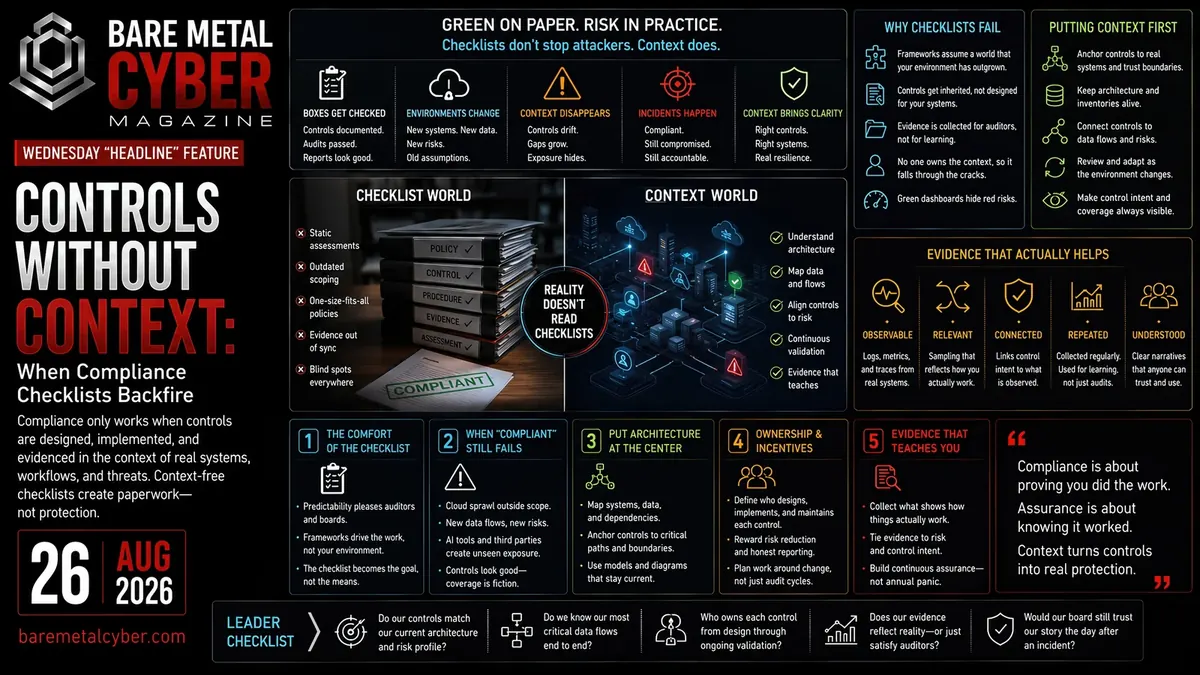
The Comfort of the Checklist
There is a reason checklists are so attractive to leaders. In a world of shifting architectures, constrained headcount, and constant board scrutiny, a dense control matrix feels like certainty you can hold in your hands. Frameworks such as the Payment Card Industry Data Security Standard (PCI DSS), ISO standards, or sector-specific regulations arrive pre-packaged with control families, requirement numbers, and test procedures. They convert a messy risk landscape into boxes that can be filled, tracked, and reported. A CISO can point to a completed checklist and say, with some confidence, “We did what is expected.” That comfort is not imaginary; regulators, auditors, and customers often reward it.
Over time, though, the checklist itself becomes the product. Teams learn that the fastest way to reduce friction with audit and risk functions is to optimize how they answer questions, not how they design controls. You see control descriptions that read like small pieces of legislation: tightly scoped, written to be “objectively testable,” and crafted around the last assessment rather than the current architecture. Because these are the artifacts that drive audit outcomes, they quietly start to shape how work is perceived. If it is on the checklist, it must be important. If it is not, it becomes someone else’s problem.
This dynamic is reinforced by how organizations distribute responsibility. Compliance and risk teams are measured on closing observations, not on whether those observations were connected to real attack paths. External assessors are rewarded for consistency and repeatable testing methods, not for challenging the underlying scoping assumptions. Vendors promise “instant compliance” mapping their tools directly to control language, which makes it even easier to treat the checklist as the ground truth. The result is a system that gradually decouples assurance from architecture. Everyone is working hard, everyone is busy filling in fields, and yet the model of the environment baked into the paperwork is years behind what engineers actually run in production.
When “Compliant” Still Fails in Production
The most sobering moments come when an incident response review and an audit packet tell completely different stories. On one screen, you have a detailed set of controls mapped to frameworks and marked “operating effectively.” On the other, a real attack path that walked through a modern data flow nobody had modeled, using a SaaS integration that bypassed the carefully controlled perimeter. The logs that incident handlers actually used came from platforms that appear nowhere in the control inventory. The runbooks invoked in the heat of the moment bear little resemblance to the procedures described in the audit evidence. The organization is, by every formal measure, compliant. Yet it still failed in production where it counts.
These failures usually trace back to stale scoping assumptions. The original control set was scoped around a data center, a handful of business-critical applications, and a limited supplier list. Since then, the environment has morphed: workloads moved to cloud-native platforms, developers adopted managed services, business units signed their own SaaS contracts, and AI tools began to operate on sensitive data. But the control narrative never caught up. New systems are lumped into existing control statements with a hand-wavy “also covers cloud,” or worse, they are quietly excluded on the theory that “the vendor is responsible.” The checklist remains tidy, while the architecture grows wild branches.
One-size-fits-all controls compound the problem. Policies written for traditional network controls are retrofitted to software-as-a-service, identity federation, or data-sharing models, sometimes with only a few words changed. Testing steps are copied verbatim from on-premises playbooks to shared responsibility models that simply do not match. Leaders see reassuring coverage percentages without realizing that the same generic control has been stamped across very different risk surfaces. When an incident reveals the gap, the organization often blames execution rather than the underlying misalignment. The lesson is not “we broke the rules,” but “our rules never applied to this path in the first place.” Until that distinction is made explicit, “compliant” will continue to fail where modern systems actually live.
Putting Architecture Back Into Assurance
If the checklist has become the product, the way back is to put architecture at the center of assurance again. That starts with admitting that controls are not abstract requirements; they are behaviors implemented by specific components, platforms, and teams along actual data paths. A control that says “sensitive data is encrypted in transit” only means something if you can point to the systems, interfaces, and trust boundaries it applies to. Leaders who want meaningful compliance insist that every major control domain is anchored in diagrams and inventories that engineers recognize as real. The question shifts from “Is this control in place?” to “Where, concretely, does this control live in our architecture?”
This does not require turning every CISO into a chief architect, but it does demand a different working model between security, architecture, and platform teams. Instead of building control language in isolation, security and compliance staff sit with system owners to trace critical flows: customer onboarding, payment processing, data science pipelines, incident-response paths. For each flow, they identify which control obligations actually matter and where they should attach: at the identity layer, the data store, the integration bus, the application gateway, or the endpoint. The output is not a prettier checklist; it is a living map where controls are linked to concrete components and dependencies, and where changes in architecture are expected to trigger reassessment.
Once architecture is back in the loop, assurance activities can evolve beyond static “test of one sample, once a year.” Sampling strategies can be tied to real usage patterns, not arbitrary counts. Evidence requests can be tuned: screenshots and configuration exports from specific platforms, logs that show end-to-end flows, and change records that demonstrate how new services were brought under control. Over time, this approach creates a feedback loop. When engineers propose a new service or integration, one of the first questions becomes “where does it land on our control map?” Compliance work becomes an extension of architecture hygiene instead of a parallel bureaucracy, and leaders gain a far more defensible story when regulators or boards ask whether the environment is truly under control.
Ownership, Incentives, and the Model of Work
Even with architecture at the center, context-aware controls will not sustain themselves if ownership is fuzzy and incentives pull in the wrong direction. In many organizations, control design and maintenance sit with a small group of risk or compliance specialists who do not own the platforms where those controls actually live. Product teams and platform engineers experience controls as tickets and checkboxes, not as design constraints they co-own. When incidents happen or audits raise awkward questions, leaders find themselves mediating between groups that each did their part as measured, yet collectively missed the bigger picture. The operating model quietly teaches people that the real goal is satisfying the reviewer, not shaping the environment.
To change that, leaders have to be explicit about who owns context. Control narratives should not be written solely by compliance staff and then thrown over the wall. Security architects, platform owners, and product leads need to be visible co-authors of the control set that applies to their domains. Their names should appear on the diagrams, on the implementation notes, and on the periodic review schedule. That does not mean every engineer becomes a policy writer; it means every major system has a small, named group responsible for making sure the way it is secured still makes sense given the way it is built and used. Ownership becomes traceable, and it becomes much harder for outdated assumptions to linger unchallenged.
Incentives then need to reinforce this model of work. If teams are measured only on closing audit actions, they will aim for the quickest path to “no findings,” which often means minimally invasive changes and maximal storytelling. If, instead, leaders measure on reductions in exposed attack paths, faster time to bring new services into the control map, or the quality of cross-team design reviews, behavior changes. Risk and compliance functions can still track completion rates, but they also highlight when a team chooses to renegotiate a control because the environment changed. Over a few cycles, the organization learns that updating a control to reflect reality is a success, not a failure. That cultural shift is what turns controls from static obligations into part of the living model of how work is done safely.
Designing Evidence That Actually Teaches You Something
Evidence is where most compliance programs quietly give away their power. In the rush to satisfy auditors and regulators, organizations default to the easiest artifacts to produce: screenshots of settings, copies of generic policies, a few log snippets showing that something happened once. These fragments may be enough to pass a test procedure, but they rarely tell a coherent story about how the environment behaves under real load, during real change, or in the middle of a real incident. Leaders end up with thick evidence packs that are functionally unreadable and practically useless for decision-making. The effort is enormous, yet the learning value is close to zero.
A more intentional approach treats evidence as a window into the system rather than a stamp on a checklist. Instead of asking, “What file can we attach to prove this control exists?” teams ask, “What would we want to see if we were trying to understand how this control works in practice?” That question pushes the organization toward end-to-end artifacts: a sequence of logs showing a complete transaction path, a change record tied to updated diagrams and test results, a sample of access reviews that clearly distinguishes between system roles and real-world job functions. Evidence becomes narrative, not noise. It shows the control’s intent, where it sits in the architecture, and how it behaves over time.
This shift also changes how evidence is produced. Rather than scrambling before each assessment, teams design controls so that useful evidence is a natural by-product of normal operations. Monitoring dashboards capture trends that double as audit trails. Runbooks are written in a way that, when followed, automatically generate the logs and records that matter. Automation pipelines record which controls were validated as part of a deployment. The audit binder becomes a curated export from living systems, not a hand-crafted artifact factory. When leaders sit down with this kind of evidence, they can ask better questions: not “Did we attach something?” but “Does this story of our system make sense, and would we be comfortable explaining it to a regulator after a serious incident?” That is when evidence starts to teach, and when compliance finally reinforces, rather than replaces, real assurance.
Where Leaders Go From Here
At its heart, this topic is about whether your controls describe your environment as it actually is, or as it once was on a neat piece of paper. The comfort of the checklist is real: it offers structure, comparability, and a shared language with regulators and auditors. But when that comfort hardens into ritual, you end up with control narratives that have drifted away from the architectures, data flows, and working practices they are supposed to govern. The result is a split-screen reality where incident reviews and audit packets tell different stories about the same system. Leaders cannot afford that gap in a world where architectures change quickly and accountability flows upward.
Closing that gap means treating context as a first-class control parameter. Architecture, ownership, and evidence are not supporting details; they are the medium through which controls become real. When leaders insist on controls that are anchored in recognizable diagrams, co-authored by the people who own the platforms, and evidenced with artifacts that show behavior over time, the shape of the work changes. Teams learn that updating a control to match a new pattern is a sign of maturity, not a failure. Evidence production shifts from a seasonal scramble to a side effect of well-instrumented systems and disciplined change.
What changes most is how leaders see their own role. Instead of asking, “Are we compliant?” the sharper question becomes, “Can we defend that these controls make sense for how we actually operate today?” That lens turns board conversations, budget debates, and vendor decisions into opportunities to align assurance with reality. If you want a concrete starting point, ask your teams two questions: which controls feel most detached from how you really build and run, and where do incident narratives diverge from audit narratives? The work of reconnecting those threads is slow and sometimes uncomfortable, but it is how you move from paperwork that backfires to controls that genuinely help your organization survive contact with the real world.
