
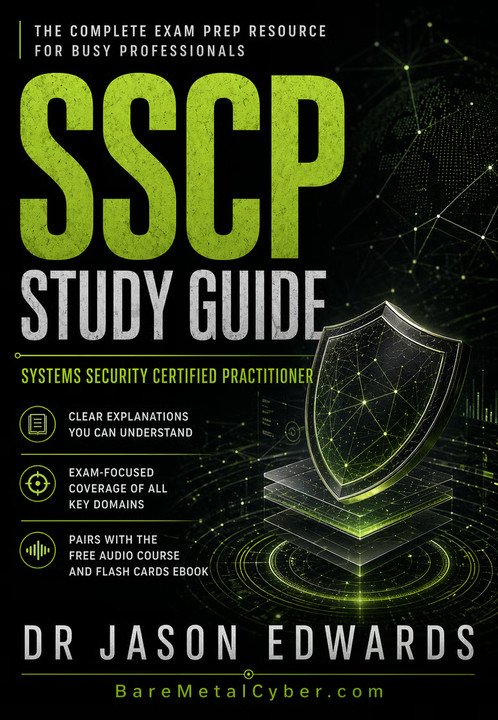
Study Guide
ISC2 SSCP Study Guide
Use the companion study guide to organize the material, compare important concepts, annotate key ideas, and build a written reference for review.
ISC2 · Free, ad-free audio course
A structured, audio-first learning route for ISC2 SSCP, designed for focused review and practical understanding.
Companion Books
The study guide helps you organize and revisit the material. The flashcards book adds active recall and rapid review across the course objectives.
Study Guide
Use the companion study guide to organize the material, compare important concepts, annotate key ideas, and build a written reference for review.

Flashcards Book
Use the flashcards book for active recall, terminology checks, rapid review, and repeated practice across the course objectives.
PUT IT INTO PRACTICE
Try 50 original BMC questions, review every explanation, and return to the lessons behind the answer. No login is required. Earn Challenge achievements and share your progress as you go.
Independent BMC learning practice—not official exam items, a full mock exam, or an exam-readiness score.

Complete Lesson Directory
Search by topic or narrow the directory by exam domain. Courses with multiple editions are organized below so every season remains easy to find. Each lesson includes its own audio player, full description, transcript when available, and previous-or-next navigation.
70 lessons available
Getting Started
Success on the SSCP begins with seeing the whole playing field clearly. This episode explains how the exam blueprint maps to core domains, how items are weighted, and what “job-task” orientation means for the kinds of questions you will face.…
Getting Started
A study plan is only effective if it fits real life and the exam’s domain weights. We begin by translating the blueprint into a calendar, balancing heavier domains with spaced repetition and short daily reviews for lighter areas.…
Getting Started
Clarity on rules and logistics protects your focus on test day. This episode explains registration steps, identification requirements, reschedule policies, accommodation requests, and the professional ethics you agree to when you sit for the exam.…
Domain 1 · Security Operations and Administration
The SSCP Code of Ethics is more than a pledge—it is a decision framework that shows up in questions and real work. We unpack the canon, its priorities, and how it interacts with organizational policy, law, and contractual duties.…
Domain 1 · Security Operations and Administration
CIA plus accountability forms the backbone of control selection and exam reasoning. We define confidentiality safeguards that restrict unauthorized disclosure, integrity measures that prevent unauthorized alteration, and availability protections that keep services dependable.…
Domain 1 · Security Operations and Administration
Technical controls only deliver value when they are mapped to clear objectives and verified in operation. This episode frames control selection around threats, assets, and required assurance levels, then ties each control to the pillar it primarily supports.…
Domain 1 · Security Operations and Administration
Physical security underpins every logical control because attackers who reach hardware can bypass software assumptions.…
Domain 1 · Security Operations and Administration
Administrative controls turn policy into consistent behavior and auditable evidence.…
Domain 1 · Security Operations and Administration
Understanding control types helps you choose the most effective safeguard and justify it clearly. We distinguish preventive, detective, and corrective controls; physical, technical, and administrative forms; and compensating controls used when preferred options are not feasible.…
Domain 1 · Security Operations and Administration
Accurate asset inventories make every other control possible. We define assets broadly—hardware, software, data, services, identities—and explain lifecycle stages from procurement and onboarding to maintenance, reassignment, and secure disposal.…
Domain 1 · Security Operations and Administration
Effective data management protects the organization legally and technically, and it is a frequent theme on the SSCP exam.…
Domain 1 · Security Operations and Administration
Change and configuration management prevent outages and security regressions, and the exam expects you to know their purpose and artifacts.…
Domain 1 · Security Operations and Administration
Awareness programs succeed when they change behavior, not just deliver slides. This episode explains how to align messages with real threats, job roles, and measurable outcomes.…
Domain 1 · Security Operations and Administration
Cyber and physical security must operate as one system, and the exam expects you to recognize where they intersect.…
Domain 1 · Security Operations and Administration
Midway through preparation, a structured recap boosts confidence and reveals gaps. This episode consolidates foundational ideas—risk, threats, vulnerabilities, controls, and assurance—into a compact mental model you can apply under time pressure.…
Domain 2 · Access Controls
Strong authentication blocks a large share of real-world compromises and appears frequently on the SSCP exam.…
Domain 2 · Access Controls
Single Sign-On (SSO) and federation reduce password sprawl while improving control, and exam items often test whether you can match the right protocol and trust model to a scenario.…
Domain 2 · Access Controls
Clear trust boundaries make designs understandable and testable, which the SSCP exam rewards in scenario questions.…
Domain 2 · Access Controls
Third-party links expand capability and risk, and the exam expects you to reason across legal, technical, and operational safeguards. We start by framing integration types—site-to-site VPNs, partner portals, API exchanges, managed service access—and the minimum controls each requires.…
Domain 2 · Access Controls
Identity lifecycle management turns policy into predictable access outcomes, and exam scenarios frequently hinge on whether accounts follow a controlled birth-to-death path.…
Domain 2 · Access Controls
Access control models translate policy into predictable, auditable decisions, and the SSCP exam often tests whether you can pick the simplest model that truly fits the scenario.…
Domain 2 · Access Controls
Strong access control depends on clean identities, clear roles, and consistent enforcement, and the exam probes whether you can spot weak links.…
Domain 3 · Risk Identification, Monitoring and Analysis
Exams reward candidates who can structure risk discussions with shared language, and organizations depend on that structure to make decisions.…
Domain 3 · Risk Identification, Monitoring and Analysis
Risk appetite expresses how much uncertainty an organization is willing to accept to achieve its goals, and the exam requires you to know how that statement guides control choices.…
Domain 3 · Risk Identification, Monitoring and Analysis
Risk reporting succeeds when it enables decisions, not when it merely lists problems, and the SSCP exam looks for candidates who can bridge security language with business outcomes.…
Domain 3 · Risk Identification, Monitoring and Analysis
Legal and privacy obligations define the guardrails within which security operates, and the SSCP exam expects familiarity with how they influence control decisions. This episode outlines key concepts: due care, due diligence, compliance, liability, and accountability.…
Domain 3 · Risk Identification, Monitoring and Analysis
Security testing provides assurance that controls perform as intended, and the SSCP exam focuses on differentiating types and objectives of testing.…
Domain 3 · Risk Identification, Monitoring and Analysis
Vulnerability management is a continuous process, and the exam expects understanding beyond simple scanning. This episode walks through each stage—discovery, assessment, prioritization, remediation, verification, and reporting—and connects them to policy and risk frameworks.…
Domain 3 · Risk Identification, Monitoring and Analysis
Security Information and Event Management (SIEM) systems convert data into situational awareness, and exam questions often test whether you can choose the right collection, correlation, and response approach.…
Domain 3 · Risk Identification, Monitoring and Analysis
Efficient analysis turns signal into action, and exam scenarios often test whether you can prioritize correctly under pressure.…
Domain 3 · Risk Identification, Monitoring and Analysis
Continuous monitoring transforms static compliance into living assurance, and the SSCP exam emphasizes how to interpret its results. This episode defines key elements—data feeds, metrics, thresholds, and escalation paths—that make ongoing oversight credible.…
Domain 3 · Risk Identification, Monitoring and Analysis
Acronyms dominate cybersecurity language, and this episode helps you translate shorthand into meaning you can recall instantly under test conditions.…
Domain 4 · Incident Response and Recovery
An effective incident response (IR) program defines who acts, how quickly, and with what authority, ensuring chaos becomes coordination. This episode covers IR policy, plan, playbooks, and communication structures that exam scenarios often reference.…
Domain 4 · Incident Response and Recovery
Early detection prevents minor issues from becoming major breaches. This episode explains how indicators of compromise (IOCs) and anomaly patterns are recognized, validated, and escalated within monitoring ecosystems.…
Domain 4 · Incident Response and Recovery
Containment and recovery distinguish controlled incidents from catastrophes, and the SSCP exam expects clarity on sequence and evidence.…
Domain 4 · Incident Response and Recovery
Proper evidence handling determines whether findings hold up under legal or disciplinary review, and the SSCP exam regularly checks understanding of this process.…
Domain 4 · Incident Response and Recovery
Incident reporting closes the accountability loop and ensures that lessons lead to improvement, not blame. This episode explains how to prepare reports that meet legal, ethical, and operational expectations.…
Domain 4 · Incident Response and Recovery
Business Continuity (BC) and Disaster Recovery (DR) ensure that essential services survive disruption, a major exam theme. We define BC as maintaining operations during adverse events and DR as restoring systems afterward.…
Domain 4 · Incident Response and Recovery
Exercises transform theory into readiness, and the SSCP exam expects you to know how testing validates plans. We define exercise types—tabletop, functional, and full-scale—and describe their purpose: measuring coordination, timing, and decision quality.…
Domain 5 · Cryptography
Cryptography protects confidentiality, integrity, and authenticity, but the SSCP exam tests whether you can match algorithms and implementations to the right purpose and sensitivity level.…
Domain 5 · Cryptography
Understanding how symmetric and asymmetric cryptography complement each other is essential for the SSCP exam.…
Domain 5 · Cryptography
Hashing provides proof that data has not been altered, making it a cornerstone of exam questions on integrity and authenticity. This episode defines a cryptographic hash as a one-way mathematical function that produces a fixed-length digest unique to input data.…
Domain 5 · Cryptography
Selecting an algorithm or key length isn’t guesswork; it’s risk-based decision-making tested heavily on the SSCP exam. This episode explains factors influencing cryptographic strength: algorithm design, key size, implementation, and operational controls.…
Domain 5 · Cryptography
Secure communication protocols feature prominently in SSCP domain questions, and this episode clarifies where each applies.…
Domain 5 · Cryptography
Public Key Infrastructure (PKI) enables scalable trust, and exam questions often probe its components and lifecycle. We define certification authorities (CAs), registration authorities (RAs), certificate repositories, and revocation mechanisms like CRLs and OCSP.…
Domain 5 · Cryptography
Reviewing cryptography in context cements knowledge, and this episode uses practical examples to connect theory with exam-ready reasoning.…
Domain 6 · Network and Communications Security
The OSI and TCP/IP models organize communication, and the SSCP exam tests your ability to connect each layer to its security controls.…
Domain 6 · Network and Communications Security
Ports and protocols are the vocabulary of connectivity, and SSCP candidates must interpret them quickly. This episode reviews common ports—HTTP 80, HTTPS 443, DNS 53, SMTP 25, SSH 22—and protocol roles in securing or exposing data.…
Domain 6 · Network and Communications Security
Recognizing attack patterns lets defenders predict behavior instead of merely reacting, a key skill tested in the SSCP exam.…
Domain 6 · Network and Communications Security
Network attacks often exploit trust and scale, and the SSCP exam assesses how well you can neutralize them. This episode explains the mechanics of Distributed Denial of Service (DDoS), man-in-the-middle (MITM), and poisoning attacks like ARP, DNS, and cache corruption.…
Domain 6 · Network and Communications Security
Network authentication frameworks define who connects and with what privileges, a recurring focus on the SSCP exam.…
Domain 6 · Network and Communications Security
Segmentation limits blast radius, improves performance, and appears across multiple SSCP domains.…
Domain 6 · Network and Communications Security
Firewalls and related technologies enforce boundaries between zones, a fundamental competency for SSCP professionals. This episode explains packet-filtering, stateful, and next-generation firewalls, emphasizing rule evaluation order, implicit denies, and policy documentation.…
Domain 6 · Network and Communications Security
Modern enterprises combine multiple protective systems, and the SSCP exam expects you to understand how these integrate without conflict.…
Domain 6 · Network and Communications Security
Wireless networks extend enterprise reach—and risk—and the SSCP exam stresses understanding their protections. This episode describes core wireless security standards: WPA3 with SAE authentication, enterprise 802.1X integration, and encryption protocols that protect data in transit.…
Domain 6 · Network and Communications Security
Internet of Things (IoT) ecosystems expand the attack surface by introducing diverse, often constrained devices that run long-lived firmware and communicate over specialized protocols.…
Domain 6 · Network and Communications Security
Solid network fundamentals enable fast, confident choices under test pressure.…
Domain 7 · Systems and Application Security
Malware analysis on the SSCP exam focuses on recognizing behaviors and artifacts rather than reverse-engineering internals.…
Domain 7 · Systems and Application Security
Social engineering exploits attention, trust, and time pressure, so defenses must combine technology, process, and human habits.…
Domain 7 · Systems and Application Security
Host protections remain a last, critical line of defense, and the SSCP exam expects you to differentiate prevention, detection, and containment on endpoints.…
Domain 7 · Systems and Application Security
Endpoint protection is strongest when encryption, application control, and policy enforcement work together.…
Domain 7 · Systems and Application Security
Modern fleets mix corporate-owned devices with bring-your-own-device (BYOD), demanding layered controls.…
Domain 7 · Systems and Application Security
Cloud topics appear across SSCP domains, and clarity on models is essential. We define deployment models—public, private, community, and hybrid—and service models—Infrastructure as a Service, Platform as a Service, and Software as a Service.…
Domain 7 · Systems and Application Security
Legal and contractual duties do not vanish in the cloud; they shift and require careful mapping. This episode explains shared responsibility: providers secure the infrastructure they run, while customers configure and govern what they deploy.…
Domain 7 · Systems and Application Security
Protecting data in the cloud means aligning technical safeguards with service-level commitments and third-party risk oversight.…
Domain 7 · Systems and Application Security
Virtualization concentrates risk and enables resilience, so the SSCP exam expects you to understand both the power and the pitfalls. This episode clarifies core concepts—hypervisors (type 1 vs.…
Domain 7 · Systems and Application Security
Hypervisors and containers minimize overhead differently, which changes how isolation can fail and how you defend it.…
Domain 7 · Systems and Application Security
This capstone pulls together system and application safeguards into one coherent playbook, mirroring how exam scenarios blend layers.…
Exam Strategy and Review
Fast recall of precise meanings accelerates problem solving on exam day, so this episode presents a plain-language mini-glossary woven into context rather than alphabet soup.…
Exam Strategy and Review
The SSCP’s adaptive format rewards steady decision-making and penalizes wasted time, so tactics matter as much as knowledge. We explain how adaptive scoring selects items near your current ability estimate, why early stability helps, and how to pace without clock anxiety.…
Try another term or clear one of the filters.
A Practical Study Routine
Use the free audio course during a commute, walk, workout, or focused study session.
Use the study guide to organize the material, annotate key ideas, and build a reference you can return to.
Use the flashcards book to practice active recall and quickly revisit weak areas.
Related Magazine Features


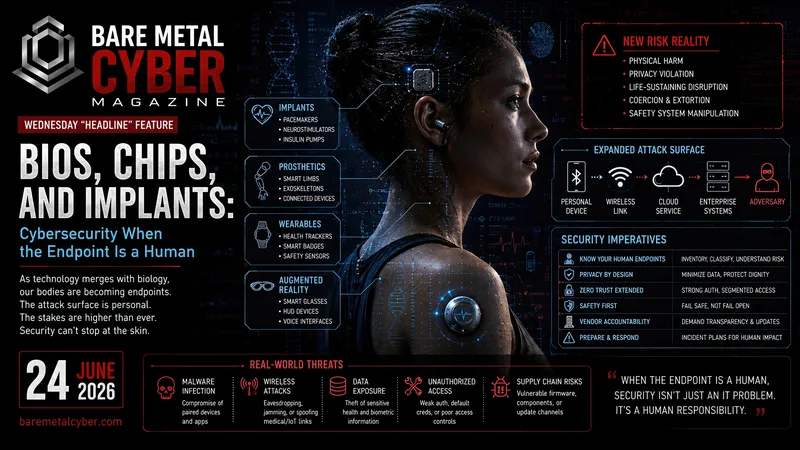
Related Cyber Wiki
802.1X Network Access Control is part of the process used to establish identity, make access decisions, control privileges, or maintain trusted sessions.
AI assuranceAI control design effectiveness asks whether a control, as documented and configured, is capable of preventing, detecting, or correcting the risk it was selected to address.
AI controlsAI control monitoring observes whether preventive, detective, and corrective controls remain active, correctly configured, sufficiently covered, and effective as systems change.
AI safety engineeringAI guardrail engineering implements enforceable limits around model inputs, outputs, tools, data, and operating conditions.
AI incident responseAI incident notification governance defines when, how, and by whom AI-related events are escalated to leaders, customers, regulators, vendors, legal counsel, and affected parties.
Generative AI application securityAI output validation treats generated text, code, commands, queries, and structured data as untrusted until the consuming system verifies it.