

Study Guide
CompTIA Project+ Study Guide
Use the companion study guide to organize the material, compare important concepts, annotate key ideas, and build a written reference for review.
CompTIA · Free, ad-free audio course
A structured, audio-first learning route for CompTIA Project+, designed for focused review and practical understanding.
Companion Books
The study guide helps you organize and revisit the material. The flashcards book adds active recall and rapid review across the course objectives.
Study Guide
Use the companion study guide to organize the material, compare important concepts, annotate key ideas, and build a written reference for review.
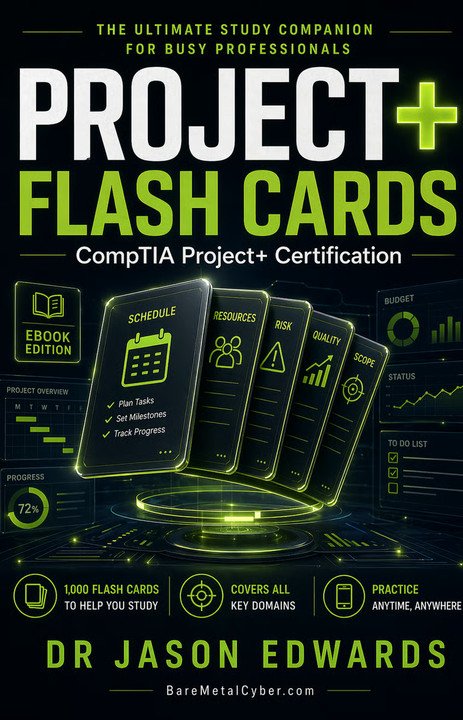
Flashcards Book
Use the flashcards book for active recall, terminology checks, rapid review, and repeated practice across the course objectives.
PUT IT INTO PRACTICE
Try 50 original BMC questions, review every explanation, and return to the lessons behind the answer. No login is required. Earn Challenge achievements and share your progress as you go.
Independent BMC learning practice—not official exam items, a full mock exam, or an exam-readiness score.

Complete Lesson Directory
Search by topic or narrow the directory by exam domain. Courses with multiple editions are organized below so every season remains easy to find. Each lesson includes its own audio player, full description, transcript when available, and previous-or-next navigation.
87 lessons available
Getting Started
This opening episode sets the stage for your Project Plus certification journey by introducing the structure, objectives, and intended learning outcomes of the PrepCast series.…
Getting Started
In this episode, you’ll gain a detailed understanding of what the CompTIA Project+ certification is, including the knowledge areas it covers and the skills it validates.…
Getting Started
This episode focuses on building a study plan that maximizes your readiness for the exam while fitting into your existing schedule. It covers how to break down the official exam objectives into manageable sections, identify your weak areas, and allocate time accordingly.…
Getting Started
Here, we break down the PK0-005 exam structure so you know exactly what to expect on test day.…
Getting Started
This episode offers techniques to help you commit critical definitions, acronyms, and process flows to memory for both the exam and real-world application.…
Getting Started
This episode focuses on leveraging official CompTIA resources and high-quality third-party materials to strengthen your study plan. We’ll discuss why starting with the official exam objectives is critical for understanding the precise scope of the PK0-005 certification.…
Getting Started
In this episode, we explore techniques to manage your time effectively during both preparation and the actual PK0-005 exam. You’ll learn how to create a realistic study schedule that accounts for your work and personal commitments while still covering all exam domains.…
Getting Started
This glossary-focused episode covers foundational terms from the letters A to G, all of which are critical for success on the PK0-005 exam. We begin by clearly defining each term, explaining how it appears in project management contexts, and why it is likely to be tested.…
Getting Started
This episode continues the glossary series, covering terms from H to P. Each definition is presented with clarity, showing how the term is used in both exam scenarios and professional project management practice.…
Getting Started
The final glossary installment covers terms from Q to Z, completing your reference set for the PK0-005 exam. Definitions are introduced with precision, focusing on relevance to project management practices and how each might be encountered in exam questions.…
Domain 1 · Project Management Concepts
In this episode, we define what makes an initiative a true project under PK0-005 standards, differentiating it from ongoing operations.…
Domain 1 · Project Management Concepts
This episode explores how projects relate to larger organizational structures, focusing on programs and portfolios.…
Domain 1 · Project Management Concepts
Here, we introduce the most widely used project management methodologies and explain their relevance to the PK0-005 exam. You’ll learn how the linear, sequential approach of Waterfall differs from the iterative, adaptive nature of Agile.…
Domain 1 · Project Management Concepts
This episode focuses on specific Agile frameworks and practices you’ll need to recognize for the exam. We begin with Scrum, detailing its roles, events, and artifacts, and how it fosters transparency, inspection, and adaptation.…
Domain 1 · Project Management Concepts
In this episode, we examine PRINCE2, a process-driven project management methodology that emphasizes governance, documentation, and clearly defined roles. You’ll learn its principles, themes, and processes, and how they differ from Agile and hybrid approaches.…
Domain 1 · Project Management Concepts
This episode dives deeper into the comparative strengths and weaknesses of Agile and Waterfall, focusing on their handling of flexibility, budget control, and time management.…
Domain 1 · Project Management Concepts
In this episode, we explore how team composition and communication styles vary between methodologies and project environments.…
Domain 1 · Project Management Concepts
This episode provides practical decision-making guidance for selecting between Agile and Waterfall. We start with criteria such as project complexity, requirement stability, and the need for stakeholder feedback.…
Domain 1 · Project Management Concepts
In this episode, we break down the first stages of change control, beginning with the creation or receipt of a change request. You’ll learn how to properly document each request in a change control log, ensuring it captures necessary details for later review.…
Domain 1 · Project Management Concepts
This episode continues the change control process by examining impact assessments and decision-making. You’ll learn how to evaluate potential effects on scope, budget, schedule, and resources, and why both qualitative and quantitative analysis are important.…
Domain 1 · Project Management Concepts
This episode covers the final stages of the change control process, focusing on effective communication, implementation, and validation.…
Domain 1 · Project Management Concepts
In this episode, we distinguish between legitimate scope change and uncontrolled scope creep. We define scope change as a formally approved adjustment to project deliverables, while scope creep occurs when unauthorized or unplanned work expands the project boundaries.…
Domain 1 · Project Management Concepts
This episode introduces the fundamentals of project risk management, starting with the definition of risk as any uncertain event that can positively or negatively affect project objectives.…
Domain 1 · Project Management Concepts
In this episode, we compare qualitative and quantitative risk assessment techniques, detailing their purposes and applications. Qualitative analysis focuses on factors like probability, impact, and detectability, using methods such as probability-impact matrices to prioritize risks.…
Domain 1 · Project Management Concepts
This episode examines common strategies for responding to both negative and positive risks. For negative risks, you’ll learn how to avoid, mitigate, transfer, or accept potential threats based on their probability and impact.…
Domain 1 · Project Management Concepts
This episode explains the relationships between risks, issues, and project changes, a concept that often appears in PK0-005 exam scenarios.…
Domain 1 · Project Management Concepts
In this episode, we focus on effective issue management, beginning with proper identification and tracking. You’ll learn the importance of using a centralized issue log to record details, assign ownership, and track resolution progress.…
Domain 1 · Project Management Concepts
This episode covers how to develop structured resolution plans for project issues, starting with root cause analysis to identify the underlying problem. You’ll learn how to assess severity based on factors such as scope impact, urgency, and potential harm to project objectives.…
Domain 1 · Project Management Concepts
In this episode, we explore temporary solutions—known as workarounds—that allow projects to continue despite unresolved issues. You’ll learn how workarounds differ from permanent fixes and when they are an appropriate choice.…
Domain 1 · Project Management Concepts
This episode introduces the first steps of project scheduling, beginning with identifying milestones and defining activities.…
Domain 1 · Project Management Concepts
This episode explains the different types of task dependencies that influence project scheduling. Hard logic, or mandatory dependencies, represent relationships that cannot be altered, such as completing design before development.…
Domain 1 · Project Management Concepts
In this episode, we focus on the four primary types of task relationships: finish-to-start, start-to-start, finish-to-finish, and start-to-finish. We’ll define each relationship type and explain how it affects scheduling logic and sequencing in a project plan.…
Domain 1 · Project Management Concepts
This episode covers estimation techniques for project resources, contingency buffers, and Agile story points. You’ll learn how to determine resource requirements for each activity by considering complexity, skill level, and availability.…
Domain 1 · Project Management Concepts
In this episode, we link Agile sprint planning with traditional scheduling concepts like critical path analysis.…
Domain 1 · Project Management Concepts
This episode examines the difference between quality management and performance management in projects. Quality focuses on meeting requirements and delivering outputs that are fit for purpose, while performance measures efficiency, timeliness, and cost-effectiveness.…
Domain 1 · Project Management Concepts
This episode focuses on the measurement tools and performance indicators that help project managers track progress and maintain accountability.…
Domain 1 · Project Management Concepts
In this episode, we review the various testing methods used to verify deliverables before project completion. Unit testing checks individual components, while regression testing ensures that new changes don’t break existing functionality.…
Domain 1 · Project Management Concepts
This episode clarifies the difference between verification and validation, two concepts frequently tested on the PK0-005 exam. Verification ensures that deliverables meet documented specifications, while validation confirms that they fulfill the intended use and stakeholder needs.…
Domain 1 · Project Management Concepts
In this episode, we examine different communication methods and their application in project environments. Synchronous methods, like meetings and calls, occur in real time, while asynchronous methods, such as email or recorded updates, allow for delayed responses.…
Domain 1 · Project Management Concepts
This episode addresses common challenges to effective communication in projects, including time zone differences, cultural variations, and technological limitations.…
Domain 1 · Project Management Concepts
This episode covers the practices for preserving and protecting project communication records, which are essential for compliance, traceability, and knowledge management.…
Domain 1 · Project Management Concepts
In this episode, we break down the main categories of project meetings and their distinct purposes. Collaborative meetings, like workshops and brainstorming sessions, encourage joint problem-solving.…
Domain 1 · Project Management Concepts
This episode focuses on structuring meetings for maximum productivity. We define key roles such as facilitator, scribe, and attendees, explaining how each contributes to meeting effectiveness.…
Domain 1 · Project Management Concepts
In this episode, we explain how to transition meetings into actionable outcomes. You’ll learn how to document action items clearly, assign ownership, and set deadlines for completion.…
Domain 1 · Project Management Concepts
This episode consolidates the key concepts from Domain 1 of the PK0-005 exam, reinforcing your understanding of project definitions, methodologies, change control, risk, issue management, scheduling, quality, and communication.…
Domain 2 · Project Life Cycle Phases
This episode begins Domain 2 by focusing on the discovery or concept preparation phase of a project. We explain how the business case establishes the rationale for undertaking the project, defining the problem, opportunity, or goal it aims to address.…
Domain 2 · Project Life Cycle Phases
This episode examines how client-imposed constraints and existing agreements can shape a project before work begins. Constraints may include budget limits, fixed deadlines, compliance requirements, or technology preferences.…
Domain 2 · Project Life Cycle Phases
In this episode, we break down the project initiation phase starting with the creation of the project charter.…
Domain 2 · Project Life Cycle Phases
This episode focuses on identifying, categorizing, and engaging stakeholders during the initiation phase. You’ll learn techniques for assessing stakeholder influence, interest, and expectations, as well as how to prioritize engagement based on project needs.…
Domain 2 · Project Life Cycle Phases
In this episode, we explain how to develop a Responsibility Assignment Matrix (RACI) to clarify roles and responsibilities from the outset.…
Domain 2 · Project Life Cycle Phases
This episode introduces the planning phase with a focus on evaluating available resource pools and determining early procurement needs.…
Domain 2 · Project Life Cycle Phases
In this episode, we explore how to assemble an effective project team by assigning roles and responsibilities based on skills and availability. You’ll learn how clear assignments support accountability, collaboration, and performance tracking.…
Domain 2 · Project Life Cycle Phases
This episode explains how to clearly define project scope during planning, starting with a detailed scope statement that outlines deliverables, boundaries, and acceptance criteria.…
Domain 2 · Project Life Cycle Phases
In this episode, we examine how to create a project schedule that aligns with resources, scope, and constraints. You’ll learn how to establish cadences, sequence tasks, and integrate milestones, as well as how to estimate durations accurately.…
Domain 2 · Project Life Cycle Phases
This episode covers the critical planning activities of identifying risks, creating quality assurance (QA) plans, and preparing for project transition or release.…
Domain 2 · Project Life Cycle Phases
This episode examines the comprehensive project management plan, the master document that integrates all subsidiary plans into a single reference for execution and control.…
Domain 2 · Project Life Cycle Phases
In this episode, we explore how to guide a project team and stakeholders through organizational change during execution. You’ll learn how to assess impacts, prepare targeted communication, deliver training, and reinforce adoption of new processes or technologies over time.…
Domain 2 · Project Life Cycle Phases
This episode focuses on three execution-phase activities that keep projects on track: running effective meetings, managing vendor relationships, and maintaining accurate status reports.…
Domain 2 · Project Life Cycle Phases
In this episode, we address conflict management strategies, including smoothing, forcing, compromise, collaboration, and avoidance. You’ll learn when each approach is appropriate, how it impacts team morale, and its potential influence on project outcomes.…
Domain 2 · Project Life Cycle Phases
This episode concludes Domain 2 by detailing the activities involved in formally closing a project. We’ll discuss validating deliverables, finalizing and closing contracts, reconciling budgets, and archiving documentation for compliance and future reference.…
Domain 3 · Tools and Documentation
This episode opens Domain 3 by focusing on visual tools used to track and manage project progress.…
Domain 3 · Tools and Documentation
In this episode, we examine two tools that enhance transparency and coordination in projects: dashboards and organizational charts. Dashboards consolidate project metrics such as progress, budget, risks, and issues into a single view for quick decision-making.…
Domain 3 · Tools and Documentation
This episode explains the role of logs and registers in tracking and controlling project elements throughout the life cycle. We define issue logs, risk registers, defect logs, and change logs, highlighting the purpose, structure, and maintenance requirements for each.…
Domain 3 · Tools and Documentation
In this episode, we cover three distinct but interconnected tools. Version control systems manage document and file changes over time, ensuring accuracy and enabling rollback when needed.…
Domain 3 · Tools and Documentation
This episode focuses on communication platforms and their roles in project management. We compare email for formal correspondence, SMS and chat for rapid updates, video conferencing for rich, synchronous discussions, and enterprise social networks for collaborative knowledge sharing.…
Domain 3 · Tools and Documentation
This episode examines collaboration platforms that enable teams to work together efficiently, regardless of location. Real-time editors allow multiple contributors to work on documents or code simultaneously, improving speed and reducing version conflicts.…
Domain 3 · Tools and Documentation
In this episode, we focus on workflow automation and e-signature platforms, both of which streamline project processes. Workflow platforms coordinate task assignments, enforce approval paths, and provide visibility into process status, reducing manual tracking.…
Domain 3 · Tools and Documentation
This episode explores meeting-focused tools that support planning, engagement, and participation. Calendaring tools coordinate availability and send reminders, ensuring maximum attendance.…
Domain 3 · Tools and Documentation
In this episode, we review core productivity software that supports project documentation, planning, and reporting. Word processors create formal documents such as charters, contracts, and status reports.…
Domain 3 · Tools and Documentation
This episode examines the different deployment models for project scheduling tools. Cloud-based solutions offer accessibility, scalability, and easier collaboration, while on-premise tools may provide greater control, customization, and security for sensitive projects.…
Domain 3 · Tools and Documentation
This episode focuses on case management and ticketing systems, which are essential in projects involving significant customer or user support. Case management tools track issues from initial report through resolution, maintaining detailed histories for accountability and improvement.…
Domain 3 · Tools and Documentation
In this episode, we examine data visualization tools that guide decision-making and performance assessment. Pareto charts identify the most significant issues by showing frequency or impact, helping prioritize corrective actions.…
Domain 4 · Basics of IT and Governance
This episode opens Domain 4 by defining Environmental, Social, and Governance (ESG) factors and their relevance to project management. Environmental aspects involve the project’s impact on resources, emissions, and sustainability.…
Domain 4 · Basics of IT and Governance
In this episode, we dive deeper into the environmental and social components of ESG. Environmental impacts may include energy use, waste generation, and effects on local ecosystems. Social impacts can involve job creation, community engagement, and cultural considerations.
Domain 4 · Basics of IT and Governance
This episode focuses on the governance aspect of ESG, explaining how adherence to corporate policies, ethical guidelines, and regulatory frameworks shapes project execution.…
Domain 4 · Basics of IT and Governance
This episode examines the physical security measures that protect project assets, covering devices, removable media, and facilities. For devices, we discuss safeguards such as cable locks, secure storage, and inventory tracking.…
Domain 4 · Basics of IT and Governance
In this episode, we focus on operational security measures designed to protect projects from insider threats and ensure only authorized personnel have access to sensitive functions.…
Domain 4 · Basics of IT and Governance
This episode covers the digital access controls used to secure systems and data in projects. We explain how to manage permissions through role-based access, enforce least-privilege principles, and set up approval workflows for elevated permissions.…
Domain 4 · Basics of IT and Governance
In this episode, we focus on classifying data according to sensitivity and regulatory requirements. We define categories including intellectual property (IP), personally identifiable information (PII), personal health information (PHI), and national security-related data.…
Domain 4 · Basics of IT and Governance
This episode examines how corporate IT policies shape project work by defining rules for branding, access control, and acceptable use. Branding policies ensure consistent visual identity in deliverables, while access policies control who can use corporate systems and data.…
Domain 4 · Basics of IT and Governance
This episode explores how compliance requirements and confidentiality obligations influence project planning and execution.…
Domain 4 · Basics of IT and Governance
In this episode, we focus on privacy laws that vary across jurisdictions and industries. We explain the implications of regulations such as the EU’s General Data Protection Regulation (GDPR), the California Consumer Privacy Act (CCPA), and health-sector requirements like HIPAA.…
Domain 4 · Basics of IT and Governance
This episode introduces core IT infrastructure concepts relevant to project management. We explain the components of computing architectures, including servers, clients, and multitiered structures.…
Domain 4 · Basics of IT and Governance
In this episode, we explain the primary cloud service models—Software as a Service (SaaS), Platform as a Service (PaaS), Infrastructure as a Service (IaaS)—and the broader category of Anything as a Service (XaaS).…
Domain 4 · Basics of IT and Governance
This episode reviews major categories of enterprise software platforms and their roles in project environments.…
Domain 4 · Basics of IT and Governance
This episode examines change control processes specific to IT infrastructure and software projects. We explain how to plan for downtime or maintenance windows to minimize business disruption, including scheduling during off-peak hours and securing necessary approvals.…
Domain 4 · Basics of IT and Governance
In this episode, we explore modern deployment practices and infrastructure structures. Continuous Integration/Continuous Deployment (CI/CD) processes are explained as automated workflows that speed up delivery while maintaining quality through frequent testing and integration.…
Try another term or clear one of the filters.
A Practical Study Routine
Use the free audio course during a commute, walk, workout, or focused study session.
Use the study guide to organize the material, annotate key ideas, and build a reference you can return to.
Use the flashcards book to practice active recall and quickly revisit weak areas.
Related Magazine Features
Related Cyber Wiki
An agile mindset applies learning, customer value, collaboration, transparency, adaptation, and sustainable delivery as decision principles rather than as a set of ceremonies.
Agile deliveryAgile tailoring selects and adjusts practices to fit the product, team, risk, governance, technology, and organizational environment while preserving rapid learning and value delivery.
AI risk assessmentAn algorithmic impact assessment examines purpose, affected people, benefits, harms, data, rights, alternatives, controls, and residual risk before a consequential AI use proceeds.
Value-management practiceBenefits realization governs whether technology and security investments produce the intended measurable outcomes after delivery.
Project managementBusiness environment change response evaluates external and internal shifts that may alter project scope, assumptions, priorities, viability, compliance, or expected value.
Governance structureCloud account and resource hierarchies organize tenants, organizations, accounts, subscriptions, projects, folders, resource groups, and resources into manageable administrative boundaries.
